
The Virtues of Down-Time
There is a noticeable trend among today's parents to keep their children of all ages busy with structured activities at all times.
Read MoreYou don't have to be a mathematician to enjoy doing math in your spare time or with your family. Math is all around us, whether we are aware of it or not. With that in mind, here are three everyday opportunities to engage in math with your child.
1. Math at the Grocery Store
 Children love to accompany their parents to the grocery store and cross items off the checklist. While you shop with your child you can:
- Ask them to help you count the total number of items and figure how many items you still have to find;
- Weigh your produce, like a bunch of grapes, and estimate the cost based on the weight;
- Look at the size of different fruits, like oranges and apples. Guess how many oranges will weigh as much as two apples. Then check your prediction!
- Ask your child to help you decide which of a similar product is the least and most expensive by comparing cost per amount.
2. Math in the Car
 No matter how old your child is or how long your drive is, there are lots of math activities that you can play on the go.
Younger children can look for cars with the largest wheels, cars that have license plates that don't repeat any letters or numbers, or count cars that are the same color as your car.
Older children can answer more involved questions. Try asking them:
- Are there more small cars or SUVs on the road? For one minute, count the number of small cars and SUVs that you pass. Will your answer change if you count for 2 minutes instead?
- Try to determine different fractions of cars that you pass (i.e. green cars, SUV, cars with no passengers, etc.)
- What was the highest speed that your speedometer reached on your drive? How long was the trip and how much time did it take? How much time would it have taken if you’d manage to drive all the way at that highest speed? What was your average speed?
Trips in the car are also an excellent time to practice multiplication tables. Start by asking 5 multiplication questions and then have your child ask you 5 multiplication questions too. This way your child can check your answers as well!
3. Math in the Kitchen
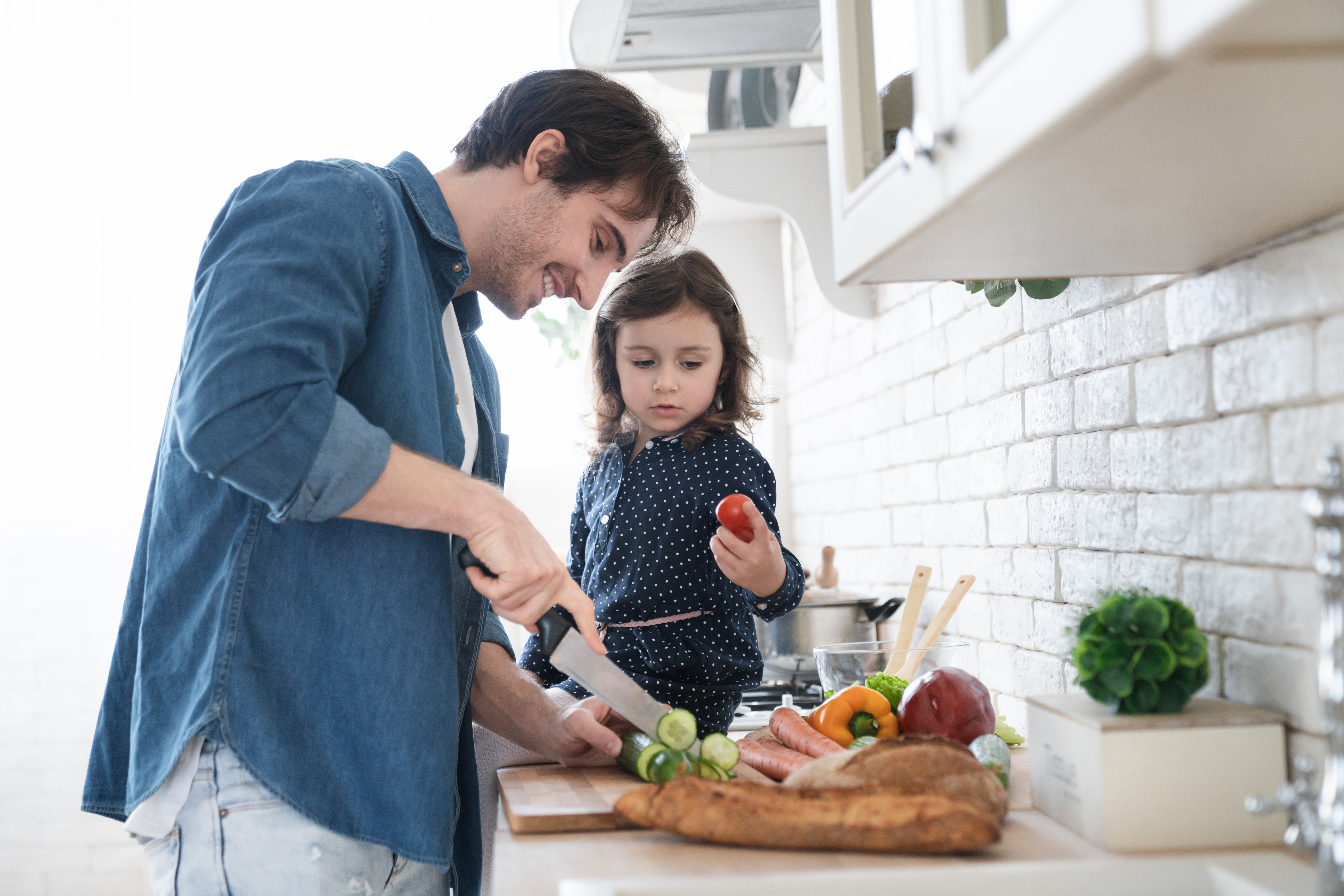 Whatever you may be cooking for dinner, there is math to be found in your kitchen. If you happen to have both a dozen jumbo eggs and a dozen extra large eggs, ask your child:
- Are the eggs really that different? Is the difference within each dozen as big as the difference between them? Which egg in each dozen is the largest and the heaviest?
- You can both measure (or estimate) the “lengths” of eggs and their weights. It may be surprising that the eggs vary in weight much more than in length.
Slicing things can also be a great way to introduce math:
- Let's say we have a round cake. Can you cut it into 4 equal pieces with only 2 cuts?
- Ask your child, if the whole cake is 1 lb, how heavy is each of 4 pieces? What if you cut the cake into 6 pieces instead?
These everyday, yet engaging activities can help you incorporate math into your family life. We hope you give them a try!

